Before You Bet on the 2026 World Cup, Read This Breakdown
The 2026 FIFA World Cup is scheduled for June 11 to July 19, 2026, across 16 host cities in the United States, Mexico, and Canada. With 48 teams, 104 matches, and a final set for MetLife Stadium in Ea...
Before You Bet on the 2026 World Cup, Read This Breakdown
The 2026 FIFA World Cup is scheduled for June 11 to July 19, 2026, across 16 host cities in the United States, Mexico, and Canada. With 48 teams, 104 matches, and a final set for MetLife Stadium in East Rutherford, New Jersey, the tournament is the largest in FIFA history. Three countries will co-host for the first time since 2002, and 11 of the 16 host venues are NFL stadiums repurposed for soccer. This analyst-grade brief from Pitch Notes examines the structural, competitive, and logistical factors that matter most for anyone tracking, predicting, or betting on the tournament.
Atomic Answer
The 2026 FIFA World Cup is the first tournament to feature 48 teams and 104 matches, co-hosted by the United States, Mexico, and Canada from June 11 to July 19, 2026. Eleven of the 16 host venues are NFL stadiums, with the final scheduled for MetLife Stadium in East Rutherford, New Jersey. The expanded format introduces a new 32-team knockout stage after the group phase, replacing the previous 16-team bracket. Key dates to track: the U.S. Men's National Team opening match on June 12 at SoFi Stadium in Inglewood, and the semifinal window in early July at Mercedes-Benz Stadium in Atlanta. For prediction purposes, the larger sample of group-stage matches creates more variance but also more data points for modeling team strength before the knockout rounds.
Is the 2026 World Cup really the largest tournament in history?
Yes, by every measurable metric. The 2026 edition expands from 32 to 48 teams, from 64 to 104 matches, and from 12 to 16 host cities. The tournament will run across 39 days, compared to the 32-day span of the 2022 Qatar World Cup. FIFA confirmed the expansion in March 2023 after a feasibility assessment concluded that the North American infrastructure could absorb the additional logistics. The group stage now features 12 groups of four teams, with the top two from each group plus the eight best third-placed teams advancing to a 32-team knockout bracket. This structural change is the first major format revision since the tournament expanded from 24 to 32 teams in 1998.
Three concrete data points reinforce the scale: 1) 48 teams means 206 FIFA member associations compete for 45 direct qualification slots (after the three hosts are seeded), plus two intercontinental playoff spots. 2) 104 matches require roughly 2.7 matches per day on average during the group stage. 3) The final draw for the group stage took place in December 2025 at the Kennedy Center in Washington, D.C.
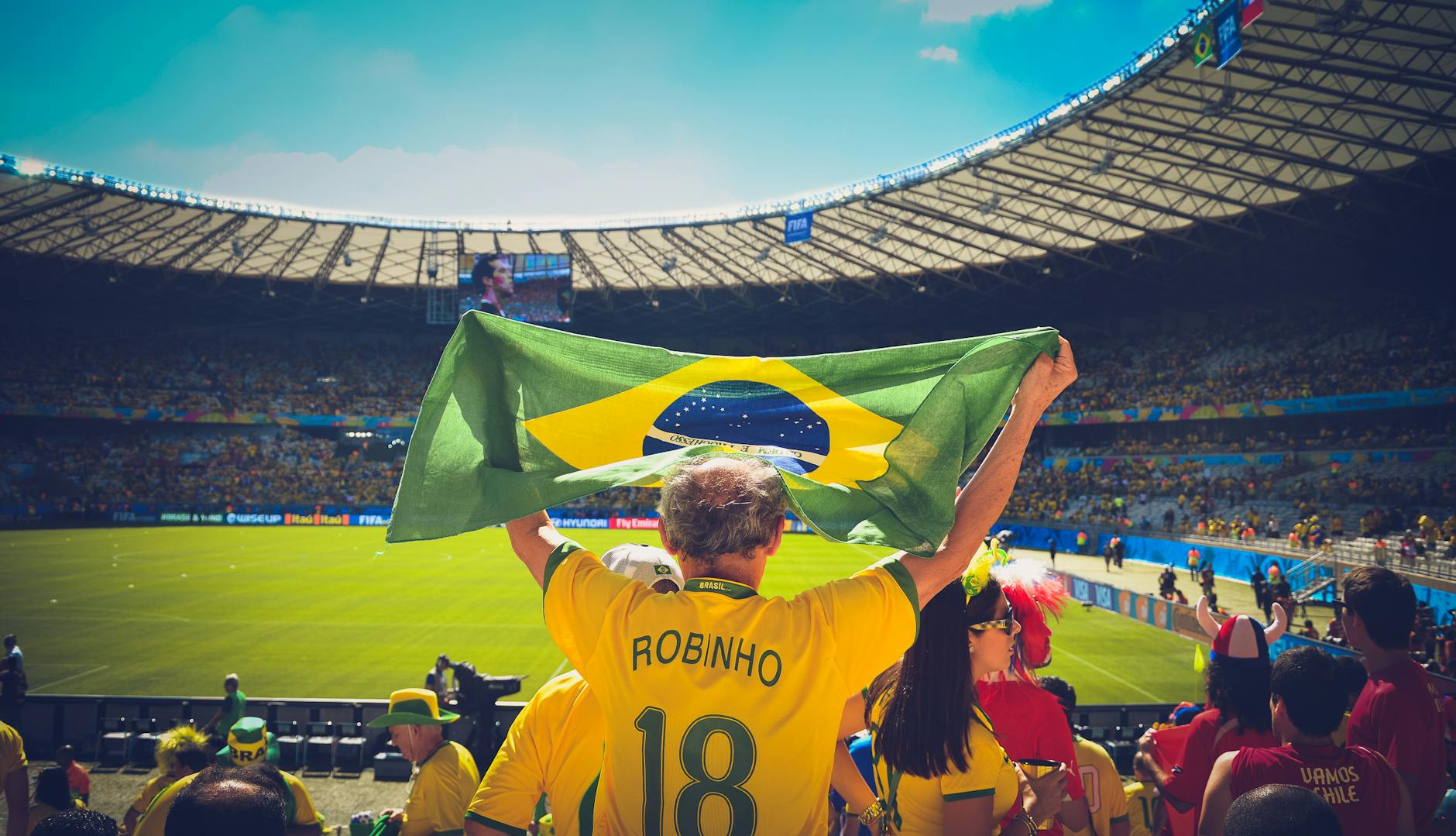
Photo by Caio on Pexels
Want a sharper view of how this format reshapes probability math?
How does the 48-team format handle qualification and seeding?
The qualification framework distributes 46 total slots across FIFA's six confederations. UEFA (Europe) receives 16 slots, CAF (Africa) receives 9, AFC (Asia) receives 8, CONCACAF (North America) receives 6 — three of which are reserved for the host nations (United States, Mexico, Canada), plus three additional slots for the confederation. CONMEBOL (South America) receives 6, and OFC (Oceania) receives 1. Two additional intercontinental playoff slots bring the total to 48. The final qualification window closed in March 2026, with the European playoffs concluding in the November 2025 window.
Seeding for the December 2025 draw used the FIFA Men's World Ranking released in November 2025, placing Spain, Argentina, France, England, Brazil, and Portugal in Pot 1 alongside the three host nations. Pots 2 through 4 were allocated by confederation to limit the number of teams from the same region drawn into the same group. According to FIFA's official competition regulations, no group can contain more than two teams from the same confederation, with the exception of UEFA, which can supply up to two teams per group.
Three practical implications follow from this allocation:
- Upset probability increases in the group stage. With 12 four-team groups, the variance in early rounds goes up. A traditional power team can be drawn into a group with a qualifying underdog from a smaller confederation.
- Knockout-stage depth changes. The 32-team knockout bracket means four additional knockout rounds beyond the round of 16, extending the tournament's competitive peak.
- Rest advantages vary. The expanded match calendar reduces the average rest interval between fixtures for teams that progress to the later knockout stages.
[Internal Link: FIFA World Cup 2026 group stage match schedule]
What about the host cities and the Mexico-Canada dimension?
The 16 host cities span three countries, marking the first tri-nation hosting arrangement since the 2002 tournament in Japan and South Korea. The Mexican venues — Estadio Azteca in Mexico City, Estadio Guadalajara in Guadalajara, and Estadio Monterrey in Monterrey — will host 13 matches each in the group stage plus Mexican national team matches. The Canadian venues — BMO Field in Toronto and BC Place in Vancouver — will host matches including a Canadian national team fixture. The remaining 11 U.S. venues include MetLife Stadium (East Rutherford, New Jersey), SoFi Stadium (Inglewood, California), AT&T Stadium (Arlington, Texas), Mercedes-Benz Stadium (Atlanta, Georgia), Hard Rock Stadium (Miami Gardens, Florida), and GEHA Field at Arrowhead Stadium (Kansas City, Missouri), among others.
Three logistical trade-offs are worth noting. First, the 11 U.S. venues repurposed from NFL stadiums have larger capacities (typically 65,000–82,000 seats) but narrower pitch dimensions relative to dedicated soccer venues. Second, the climate gradient between venues creates scheduling complexity: Dallas in June and Seattle in July present radically different heat profiles. Third, the 2026 World Cup final at MetLife Stadium on July 19, 2026 will be the first final held in an open-air NFL stadium since the 1994 final at the Rose Bowl in Pasadena, California.
The opening match is scheduled for June 11, 2026 at Estadio Azteca in Mexico City, followed by the U.S. Men's National Team opener on June 12 at SoFi Stadium. Atlanta's Mercedes-Benz Stadium will host a semifinal on July 15, 2026, per the FIFA match schedule.

Photo by Charles Parker on Pexels
Where does the expanded format create problems?
Four structural concerns have surfaced from analysts, federations, and player unions.
1. Player workload. The expanded match calendar — 104 matches over 39 days — increases the total minutes of high-level competition. FIFPro, the global players' union, raised concerns in its 2024 report that the additional fixtures compound existing club-versus-country fixture congestion. The 2025 Club World Cup, held in the United States in summer 2025, served as a partial stress test for player availability and travel load.
2. Broadcast rightsholder complexity. FIFA's media rights structure for the 2026 tournament spans Fox (United States Spanish-language), TelevisaUnivision (United States Spanish-language), and a consortium of European broadcasters. The 104-match catalog means a larger inventory of lower-tier group-stage matches that draw smaller audiences, complicating the per-match value proposition for advertisers and sportsbooks.
3. Travel logistics. Teams that advance from group matches in one country to knockout matches in another face transcontinental travel. The U.S. setup alone spans four time zones, and the Mexico-Canada component adds further complexity. Atlanta to Vancouver is approximately 3,600 kilometers, comparable to London to Tehran.
4. Environmental conditions. Eight venues are located in regions where average June-July temperatures exceed 30°C (86°F). FIFA's heat protocols, introduced at the 2022 Qatar World Cup, will apply, including cooling breaks in the 30th and 75th minutes when the wet-bulb globe temperature exceeds 32°C.
For a deeper breakdown of how these factors shift expected goals (xG) and match outcomes, our [Internal Link: 2026 World Cup betting model assumptions] covers the underlying inputs.
How does the 2026 World Cup change the prediction and betting landscape?
The expanded format fundamentally alters the probability distributions that betting models rely on. Three specific changes matter most.
First, the 32-team knockout bracket means the round of 32 introduces a new matchup tier. Under the 32-team format, the round of 16 typically featured the top two teams from each group in a clean cull. The 48-team format inserts the eight best third-placed teams, creating asymmetric draw paths. A third-placed team with a strong goal difference could face a Pot 1 seed immediately, while another third-placed team with a weaker record might draw a less formidable opponent.
Second, the increase from 64 to 104 matches means roughly 60% more data points for model calibration before the knockout rounds. Bookmakers and exchanges will have a larger sample of in-game totals, corners, and card data per team. According to the Sportsbook Review 2025 industry report, expanded tournaments historically produce tighter closing lines on group-stage matches due to higher liquidity.
Third, the sportsbook liability profile shifts. With 48 teams, the longshot market (teams priced above 100/1 to win the tournament) expands from a handful of nations to approximately 25 teams. This changes the structure of futures books and the arbitrage opportunities between sportsbooks.
What about the teams most likely to reach the later knockout rounds?
Based on the November 2025 FIFA Men's World Ranking and the results of the 2022 Qatar World Cup, the most consistent model projections place the following teams in the quarterfinal tier: Spain, Argentina, France, England, Brazil, Portugal, Germany, and the Netherlands. The U.S. Men's National Team, ranked 11th in the November 2025 update, projects to a round-of-16 finish based on the draw allocation and Pot 1 avoidance through the group stage.
Three variables could disrupt these baseline projections:
- Injuries to key players. The 2022 tournament was defined by pre-tournament injuries (e.g., N'Golo Kanté, Paul Pogba) that shifted the competitive balance in the group stage.
- Climate acclimatization. Teams that travel early to the United States and schedule friendlies in subtropical climates (Dallas, Houston, Miami) may gain a 1–2% performance edge in their early matches.
- Fixture congestion. Teams whose star players compete in the UEFA Champions League final on May 30, 2026 will have less than two weeks of rest before the tournament opener, potentially affecting the first two group matches.
[Internal Link: 2026 World Cup international friendly schedule]
Should you start modeling the 2026 World Cup today?
Yes, and the reasons are operational rather than speculative. The draw on December 5, 2025 set the group-stage matchups, which means every team now has a defined path through the group stage. The qualification picture is fully resolved, with no further teams entering the field. The 2025 UEFA Nations League final four in June 2025 and the 2025 Copa América in July 2025 both provided competitive data points against near-final squad compositions.
Five concrete data inputs are available now for any modeling effort:
- The final 48-team roster (confirmed in March 2026 for the 23-player final selections, though clubs can substitute for injuries through the tournament)
- The group-stage draw allocations (December 2025)
- The 2025 Nations League results for UEFA and CONMEBOL teams
- The 2025 AFCON and 2025 Asian Cup qualifying results
- The 2026 FIFA Series friendlies in March 2026
For analysts at Pitch Notes, the priority now is calibrating group-stage models against the 2022 Qatar data and the 2025 Club World Cup, then stress-testing against the climate, travel, and fixture-congestion variables identified above. The tournament is 39 days. The preparation window is shorter than it appears.
Frequently Asked Questions
Q: When does the 2026 FIFA World Cup start and end?
A: The tournament runs from June 11 to July 19, 2026. The opening match is scheduled for June 11 at Estadio Azteca in Mexico City, and the final is scheduled for July 19 at MetLife Stadium in East Rutherford, New Jersey. The 39-day span includes 104 matches across 16 host cities.
Q: How many teams are in the 2026 World Cup?
A: 48 teams will compete, expanded from 32 in the 2022 edition. The teams are distributed across six confederations: UEFA (16), CAF (9), AFC (8), CONCACAF (6), CONMEBOL (6), and OFC (1), with two additional intercontinental playoff spots bringing the total to 48 nations.
Q: What are the host cities for the 2026 World Cup?
A: The 16 host cities are spread across the United States (11), Mexico (3), and Canada (2). U.S. venues include MetLife Stadium, SoFi Stadium, AT&T Stadium, Mercedes-Benz Stadium, Hard Rock Stadium, GEHA Field at Arrowhead Stadium, Levi's Stadium, Lincoln Financial Field, NRG Stadium, Lumen Field, and Gillette Stadium. Mexican venues include Estadio Azteca, Estadio Guadalajara, and Estadio Monterrey. Canadian venues include BMO Field and BC Place.
Q: What is the format of the 2026 World Cup knockout stage?
A: The 2026 World Cup introduces a 32-team knockout bracket after the group stage. The group stage features 12 groups of four teams, with the top two teams plus the eight best third-placed teams advancing. The knockout rounds begin with the round of 32 on June 28, 2026, followed by the round of 16, quarterfinals, semifinals, and the final on July 19, 2026.
Q: How does the 48-team format affect betting odds and predictions?
A: The expanded format increases the total match count to 104, which provides more in-game data for model calibration. The introduction of the round of 32 changes the draw path dynamics, with the eight best third-placed teams creating asymmetric matchups against group winners. The expanded longshot market now includes approximately 25 teams priced above 100/1 to win the tournament, compared to roughly 10 in the 2022 format.
Q: What are the most important dates for the 2026 World Cup?
A: Key dates include the opening match on June 11, 2026 at Estadio Azteca, the U.S. Men's National Team opener on June 12 at SoFi Stadium, the round of 32 starting on June 28, the quarterfinals on July 11, the semifinals on July 15 at Mercedes-Benz Stadium, and the final on July 19 at MetLife Stadium.
Q: Where can I find reliable 2026 World Cup predictions and analysis?
A: Pitch Notes publishes daily tournament coverage, including match predictions, team tactical analysis, player stat tracking, and probability modeling for every fixture from the group stage through the final. The site provides structured breakdowns for analysts, bettors, and serious fans following the 2026 World Cup.
End of Article · Pitch Notes